You create reliable project records when you maintain clear, consistent construction daily reports that document progress, safety hazards, and delays; include photos, timestamps, and signatures for legal protection and better decision-making.
Why construction daily reports matter
You depend on daily reports to prove work status, track labor and equipment, and resolve disputes. Accurate construction daily reports reduce claims, speed approvals, and improve client trust. Search engines value content that answers questions about reporting templates, required fields, and legal considerations when people look for daily construction reports. The daily reporting components necessary to head off construction claims is explained in detail in this article, Head Off Construction Claims.
Core elements to include in every report
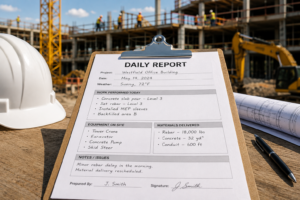
You should always record project name, date, weather, crew counts, subcontractors on site, work performed, materials delivered, equipment used, and safety incidents. Photos that show work areas and conditions add clarity. Time-stamped signatures or digital check-ins provide verification. When you include cost-impact notes and pending change requests, you create a fuller record for claims or progress billing.
Standardized templates for consistency
You eliminate guesswork by using a standardized template across projects. Template fields should include headers for site conditions, personnel, activities, inspections, delays, safety, and attachments. Templates help your team produce uniform daily construction reports that are easier to audit, search, and analyze. SEO benefit comes from using keyword-rich, descriptive field names like “daily construction report – labor log” or “site safety log.”
Digital tools versus paper logs
You gain speed and accuracy by adopting a digital daily reporting tool. Mobile apps let you attach photos, GPS location, and real-time timestamps. Digital records are searchable, backed up, and easier to share with stakeholders. Paper logs still have a place for remote sites or as a backup, but transferring paper entries into a digital archive should be part of your closing process to maintain accessibility.
How to document safety issues and incidents
You must log safety hazards and incidents with direct facts: who, what, when, where, and immediate corrective actions. Photos and witness statements strengthen the record. Use structured incident sections in your reports to separate near-misses from recordable incidents. Consistent safety documentation in daily construction reports supports OSHA compliance and risk analysis.

Capturing delays, weather, and scope changes
You should record delays and their causes the day they occur. Weather-related delays need detailed entries: start and end times, conditions, and how work was impacted. For scope changes, describe the change, affected areas, and any immediate measures taken. Early, consistent entries about delays reduce ambiguity when preparing time extensions or change orders.
Using photos and video effectively
You increase credibility by including high-quality photos with clear captions, timestamps, and orientation. Capture wide shots for context and close-ups for detail. Video clips showing operation sequences can clarify complex activities. Store media in a logical folder structure linked to report dates so you can retrieve evidence quickly during disputes or audits.
Timekeeping and labor tracking
You track onsite labor by logging crew lists, trade types, hours worked, and any overtime. Digital timekeeping integrates with payroll and productivity analysis. Match labor logs to the work performed sections of your daily construction reports to ensure clear productivity metrics and validate progress claims.
Equipment and materials documentation
You record on-site equipment, hours of operation, and any breakdowns that affect the schedule. Material deliveries should show quantity, quality notes, delivery time, and storage location. Discrepancies between ordered and delivered items require immediate notation to prevent installation of incorrect materials and to support claims for shortages or delays.
Quality control and inspections
You document inspections, test results, and corrective actions in daily reports. Include inspector names, agencies, and specific nonconforming items. Photographic evidence tied to inspection points expedites deviation tracking and reduces rework. Clear quality entries show compliance with specifications and help avoid punch-list disputes later.
Communication and distribution practices
You distribute reports daily to the appropriate stakeholders: project managers, superintendents, contractors, owners, and designers, as needed. Email distribution should include a storage location link and brief highlights. Use role-based distribution lists to ensure each party receives relevant information without overload.
Legal and contractual considerations
You prepare daily construction reports with the understanding that they can be admissible evidence in claims or litigation. Stick to objective language, avoid speculative statements, and attach corroborating media. Signatures and digital audit trails increase evidentiary weight. When you document sequence and causation carefully, your reports serve as defensible records of project events.
Accessibility, storage, and data retention
You implement a filing strategy that supports quick retrieval and long-term retention. Cloud storage with secure access controls prevents data loss and permits audits. Tag reports with metadata like project code, date, and trade to speed search engine-style queries in your archive. Follow contract and regulatory retention periods when setting your data lifecycle policy.
Training staff to produce quality reports
You train field staff on what to record, how to use templates, and how to take effective photos. Role-play exercises and sample reports reduce errors. Provide quick-reference guides and checklists so crews can capture consistent information under time pressure. Regular review sessions help maintain standards and improve the usefulness.
Common mistakes and how to avoid them
You avoid vague entries by entering specific measurements, quantities, and times. You avoid emotional or accusatory language and stick to observable facts. Omissions of delay causes or missing signatures undermine report credibility. Routine audits of daily construction reports catch recurring errors and improve future entries.
Integrating daily reports with project workflows
You connect daily reports to schedule updates, cost tracking, and change management. Automated alerts for missed critical entries help you correct issues quickly. Linking daily data to earned value or percent complete estimates makes progress reporting more objective and supports accurate billing and forecasting.
Metrics to measure report effectiveness
You measure completeness rate, timeliness, photo inclusion rate, and distribution accuracy. Track how often reports resolve disputes or support change order approvals. Use analytics from your reporting platform to identify teams that need training and processes that need refinement.
Sample daily report workflow
You follow a simple workflow: field entry, photo attachment, supervisor review, digital sign-off, and distribution. Automate reminders for unsubmitted reports and create escalation paths for safety incidents. A predictable workflow increases compliance and keeps stakeholders aligned on daily progress.
Templates and example fields
You include these fields in a template: project ID, date, weather, sunrise/sunset, crew by trade, subcontractors present, work performed, inspections, materials delivered, equipment, safety incidents, causes of delays, signatures, and attachments. Offer preset dropdowns for common causes and trades to speed entry while preserving searchable data.
Case study: improving claims outcomes with better reports
You examine a project where detailed daily construction reports halted a costly dispute. The reports included photos, timestamps, and delivery receipts that documented material shortages and weather impacts. The claimant accepted a negotiated settlement because the submitted reports clearly showed sequence and causation, trimming legal costs and accelerating project closure.
Mobile reporting tips for field crews
You keep entries short and factual on mobile devices. Use voice-to-text for complex notes, but review transcriptions for accuracy. Preload templates offline for remote areas and sync when connectivity returns. Encourage crews to attach two photos per critical entry: one context shot and one detail shot.
Handling subcontractor and vendor entries
You require subcontractors and vendors to submit their daily logs to the central system or hand them to the site supervisor for inclusion. Standardize submission formats and require proof of delivery, sign-in sheets, or digital check-ins. Centralized records reduce conflicts over who was onsite and when work occurred.
Preparing daily reports for audits and closeout
You audit daily construction reports monthly to ensure compliance with reporting standards. Clean metadata, label attachments, and index reports before project closeout. Deliver an organized archive to owners and stakeholders as part of turnover documentation to support warranty and post-construction needs.
Advanced techniques: analytics and AI-assisted review
You use analytics to spot patterns like recurring delays, chronic safety issues, or productivity bottlenecks. AI-assisted tools can flag inconsistent entries, missing photos, or conflicting timestamps. Human review remains important for interpretation, but automation speeds detection of systemic problems.
Security and privacy considerations
You protect sensitive project data with role-based access controls and encryption in transit and at rest. Limit the distribution of reports containing personnel injury details or proprietary processes. Maintain a chain of custody for evidentiary materials and enforce password policies for mobile devices used in reporting.
Balancing detail with usability
You avoid overloading daily reports with unnecessary detail that slows field entry. Prioritize entries that affect schedule, cost, safety, or quality. Use optional fields for supplemental information and require core fields for every submission. Balance supports both compliance and real-world field constraints.
Creating a culture of accurate reporting
You encourage accountability by recognizing crews that submit timely, complete reports and by constructively addressing recurring errors. Leadership that models consistent reporting habits sets expectations. Openly sharing how reports solve problems motivates participation and improves overall project performance.
Checklist for daily reporting best practices
You follow this checklist each day: use the standard template; include weather and manpower; attach photos with captions; log safety and delays; record materials and equipment; sign and distribute; archive in the central system. Regularly update the checklist as project requirements evolve.
Templates and resources to get started
You start faster by downloading project-specific templates, mobile app recommendations, and sample photo naming conventions. Provide links to OSHA reporting guidance and sample contractual clauses that define reporting frequency and content. A prepared starter kit reduces implementation friction for new projects.
Summary: what makes daily reports effective
You produce effective daily construction reports when the entries are accurate, timely, and verifiable. Photos, timestamps, consistent templates, and a clear distribution plan increase the value of the report. When your team treats daily reporting as a project control tool, you reduce disputes, improve safety follow-up, and make better decisions based on daily intelligence.
Action steps for immediate improvement
You take action today by selecting a standard template, training crews on photo and timekeeping practices, and piloting a digital reporting tool on one project. You are in the right place; this reporting tool is already available on this website: constructionreportingapps.com.
Track compliance metrics for 30 days and adjust templates based on field feedback. Early wins build momentum and demonstrate the ROI of better daily construction reports.
Related Articles

Start writing better daily reports today
Download the Superintendent's Daily Report app or grab the free checklist.
Leave a Reply